China-Iran Intelligence Report Raises New Alarm for US Forces After Deadly Attack
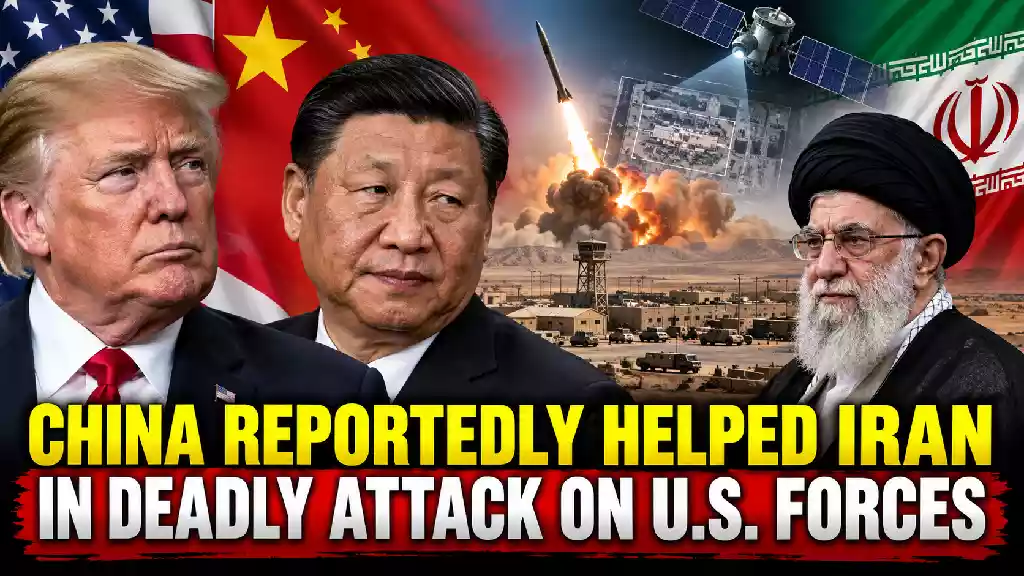
China reportedly provided satellite imagery to Iran before a deadly attack that killed three U.S. service members, raising new concerns over China-Iran military and intelligence cooperation.
China-Iran Intelligence Report Raises New Alarm for US Forces After Deadly Attack
China Reportedly Helped Iran Target US Forces in Deadly Attack Raising New Alarm in Washington
A stunning new report is raising fresh concerns about growing military and intelligence cooperation between China and Iran after a deadly attack killed three U.S. service members at a U.S. military base in Jordan.
According to reporting cited by the Wall Street Journal, Iran reportedly received satellite images of an airbase in Jordan from Chinese entities before carrying out the attack. The revelation has intensified concerns in Washington about whether China is providing Iran with intelligence that could improve Tehran’s ability to target American forces.
The report comes at a particularly sensitive moment in U.S.-China relations, with President Donald Trump and Chinese President Xi Jinping expected to meet for a high-stakes summit in Washington on September 24.
The timing could put additional pressure on Beijing as U.S. officials assess China’s potential role in helping Iran gather battlefield intelligence.
Deadly Attack on U.S. Forces in Jordan
The reported intelligence transfer is connected to a tragic attack at Muwafaq airbase in Jordan, where missiles struck and killed three American service members.
The source identifies the fallen troops as First Lieutenant Fian, Private Gonzalez and Sergeant Rampersad. The attack has renewed questions about how effectively U.S. military positions can be protected when hostile forces have access to increasingly sophisticated surveillance and targeting capabilities.
Retired Navy Captain Brent Sadler, who previously served with the China branch of the Navy staff at the Pentagon, argued that Chinese assistance to Iran should not come as a complete surprise. He characterized Beijing’s relationship with Tehran as strategically significant and warned that the United States needs to pay close attention to the intelligence dimension of the partnership.
Growing Concern Over Chinese Satellite Surveillance
The issue may extend beyond a single attack.
The source also raises concerns that Chinese satellites could be helping Iran track U.S. warships. Such assistance could potentially give Iranian forces greater awareness of the location and movements of American naval assets in the region.
For U.S. military planners, the development is particularly concerning because satellite-enabled targeting is an important component of modern warfare.
Sadler pointed to China’s development of missile systems that rely on satellite tracking and are designed to threaten U.S. aircraft carriers and warships. He suggested that conflicts involving Iran and other regional partners could provide China with opportunities to observe American military operations and learn from them.
Middle East Conflicts Could Become a Learning Ground
The concern extends beyond Iran.
The source notes that China could potentially learn from the military activities of Iranian forces and the Houthis while observing how American forces respond to drones, cruise missiles and ballistic missiles.
The U.S. Navy has gained substantial operational experience defending against these threats, including Chinese-designed ballistic anti-ship missiles. That experience could become increasingly important if tensions between Washington and Beijing rise in the Indo-Pacific.
The strategic implications are significant. Military analysts have long focused on the possibility that lessons learned in conflicts in the Middle East could influence future confrontations elsewhere, particularly in the event of a crisis involving Taiwan.
Trump-Xi Summit Faces New Pressure
The reported China-Iran intelligence connection could become another difficult issue ahead of the September 24 Trump-Xi summit.
Sadler advised President Trump to use direct and explicit language when addressing Beijing. Rather than publicly revealing every potential response, he argued that Washington should make clear that there would be consequences if China is found to be assisting Iran in ways that threaten U.S. forces.
Possible responses could include economic measures and other actions short of direct military confrontation. The central objective, according to Sadler, would be to ensure that Chinese officials understand that Washington is watching their activities and is prepared to respond.
A New Challenge for U.S. National Security
The reported satellite intelligence transfer highlights how modern conflicts increasingly extend beyond traditional battlefields.
Satellite imagery, surveillance networks and precision-guided weapons can connect events thousands of miles apart. For the United States, the possibility that a major global power could provide intelligence capabilities to a regional adversary raises difficult questions about military readiness, deterrence and national security.
With tensions already high between Washington and Beijing, the allegations surrounding China’s reported assistance to Iran could add another layer of complexity to an already consequential U.S.-China relationship.
The September 24 summit could therefore become an important opportunity for the Trump administration to seek clarity from Beijing and establish boundaries over military and intelligence cooperation that Washington considers a threat to American forces.
#China #Iran #USMilitary #USForces #MilitaryNews #ChinaIran #SatelliteIntelligence #NationalSecurity #USNavy #Trump #XiJinping #Taiwan #IndoPacific #MiddleEast